
Designed, machined, assembled and tested in‑house
Hydrodynamic design, machining, control electronics, assembly and sea trials: one engineering chain, one responsible party. No black boxes.
Axial flow, deliberately
Our pumps are axial flow by conviction: high throughput, compact packaging and strong low-speed thrust. Impeller and pump geometry are developed in-house and precision-balanced as cast stainless components.
Die-cast aluminium
The housing is die-cast marine-grade aluminium with a painted finish, lighter and more durable than sand-cast alternatives, with the repeatable dimensional accuracy that series production demands.
Specified for salt water
Duplex stainless main shaft, cast stainless impeller, GRP composite intake and a self-lubricating POM wear ring: every wetted component is chosen for prolonged salt-water exposure and abrasive load.
Controls from the same bench
Throttle, reverse, trim, steering and engine monitoring run on our own CAN-based control units. The drive and its electronics are developed together, which is why they behave as one system on the water.
Tested on our own hulls
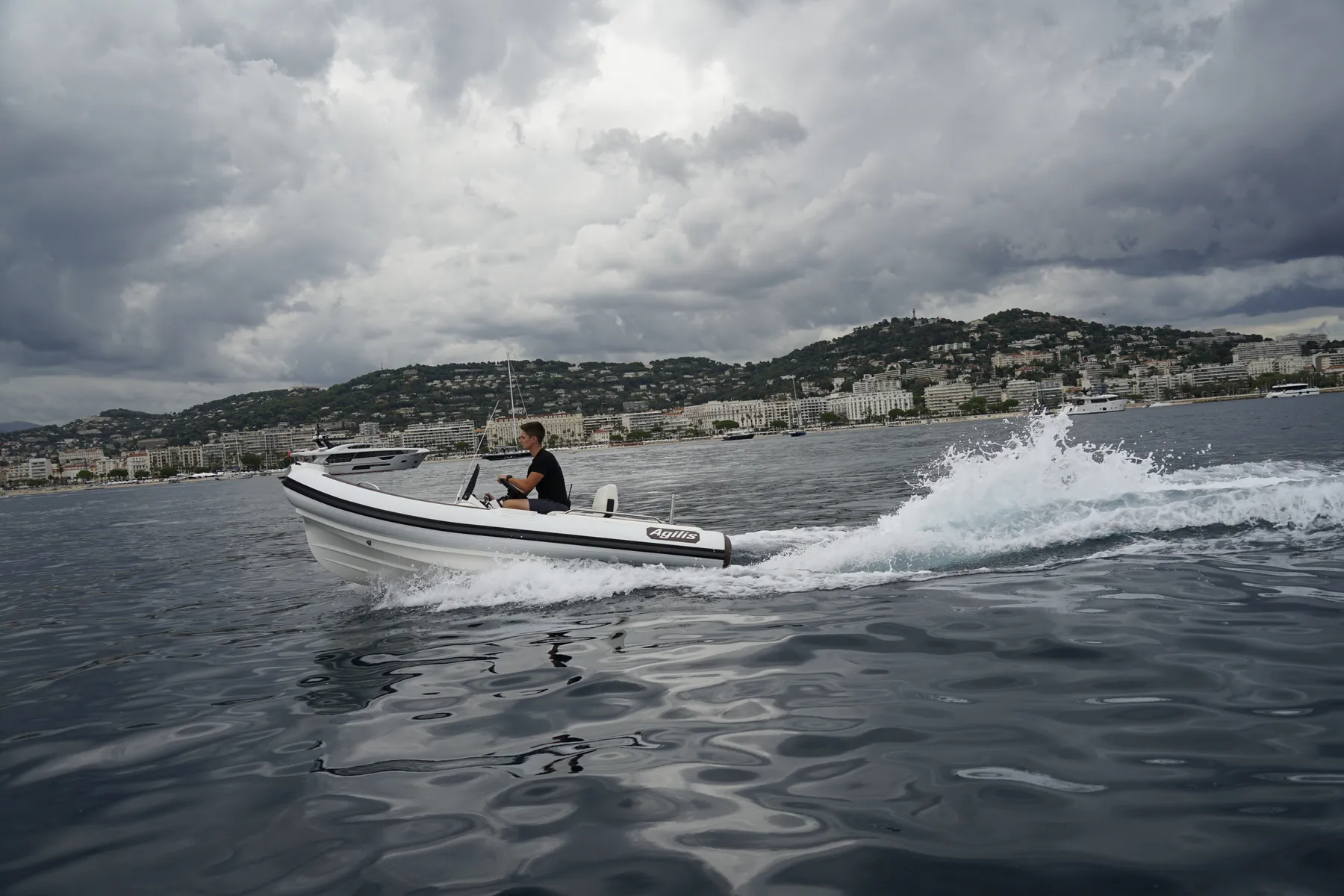
Design decisions are taken to sea aboard the Agilis 360D and 400D. We ship what we run ourselves, and the design went through multiple revisions before release.
From the boat backwards
Dimensional data, GRP installation wedges, engine matching and commissioning support: drives are engineered the way we integrate them into our own boats: from the boat backwards, not the bench forwards.
Why the units are light: die casting
A 29 kg drive that accepts 200 HP is not a measuring trick. It is a casting decision.
Sand casting cannot hold thin, consistent wall sections. The mould surface is granular, cores shift, and every pour varies, so the foundry adds material for safety and the designer adds more for the worst unit in the batch. The result is a housing sized for the process, not for the load.
Die casting fills a machined steel mould under pressure. Wall thickness holds tight and repeats identically every shot, so material sits only where load requires it. That is where the weight advantage comes from, and it is designed in, not shaved off.
For an OEM the second-order effects matter as much as the kilograms: every unit in a series is dimensionally the same drive, and there is no porosity-driven variation between housings. What we test is what you install, unit after unit.
The engineering method
Sizing is calculation, not catalogue lookup. Hull performance runs on the Savitsky planing method with a moment balance; the pump side runs on our parametric model, which inverse-designs the impeller trailing edge pitch and nozzle for the specific engine.
The model is validated against a CFD performance target and published with stated tolerances. Every published performance figure says what it is: model data with a method behind it. You can run the same calculation yourself in the performance configurator, or read the as-built technical documentation on the AWJ 200 datasheet.
Grown from Agilis Jet Tenders
Agilis Jet Technologies and Agilis Jet Tenders share ownership and engineering heritage. They are separate companies. The move into jet drives and control electronics is a natural expansion of the product line: years of experience with jet drives, and, crucially, with their integration into boats rather than just their manufacture, flow directly into every product we sell.
Put our engineering to work
From first sizing to sea trial: talk directly to the people who design the hardware.